

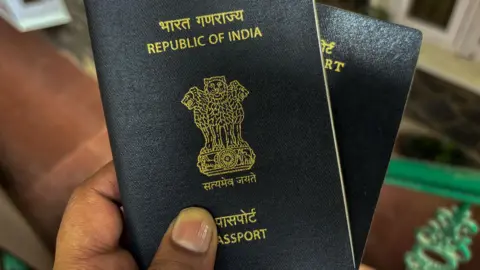
In recent months, an online clip from a popular travel content creator expressing frustration over the limited power of the Indian passport gained massive traction across digital platforms.
He mentioned that while neighbouring countries like Sri Lanka and Bhutan offered easier access of travelers from India, securing travel permits for visiting many nations in Europe and the West continued to be difficult.
This dissatisfaction with the limited global access of Indian passports was reflected in recent Henley Passport Index, ranking the country at position eighty-five out of nearly two hundred nations, five spots lower than last year.
Officials in India has not commented regarding these findings yet.
Nations including Ghana, Rwanda and Azerbaijan with much smaller economies compared to India – which is the fifth-largest economy globally – hold better positions on the index in the seventies range, respectively.
Actually, the country's position in the past decade has remained in the 80s, falling to ninetieth place in 2021. Such standings appear poor when measured against other Asian countries such as Japan, South Korea and Singapore, which have consistently held leading ranks.
What Passport Strength Indicates
Passport strength indicates a nation's soft power and international standing. This leads to better mobility for passport holders, boosting business and educational prospects. Limited passport power results in more paperwork, increased visa expenses, reduced travel benefits and longer waiting times when journeying.
But despite the decline in the rank, the number of countries providing visa-free travel for Indian citizens has grown in the past decade or so.
As an instance, eight years ago – the year the current administration's Bharatiya Janata Party (BJP) came to power – fifty-two nations provided visa-free access for Indian passport holders and its passport at seventy-sixth position in the ranking.
A year later, it tumbled to eighty-fifth place, then rose to 80th in 2023 and 2024, declining once more to the 85th position currently. Meanwhile, countries allowing visa-free travel for Indians increased from 52 in 2015 to sixty last year and sixty-two this year.
Increasing Worldwide Travel Competition
The count of nations allowing visa-free entry in 2025 (fifty-seven) is higher than the number in 2015 (52), but India's rank for both these years remains at eighty-fifth. So, why is that?
Experts say that a primary factor is the increasingly competitive landscape in global mobility – meaning nations are entering into additional travel agreements to benefit their citizens and economic growth. As per a 2025 report, the global average count of countries people can visit visa-free has almost doubled from 58 in 2006 to 109 in 2025.
As an illustration, China has expanded its count of visa-free destinations available to its citizens from 50 to 82 over the last ten years. Consequently, its rank in the ranking has improved from ninety-fourth to sixtieth in that same duration.
In comparison, The Indian passport – which was ranked at seventy-seventh place during summer – fell to eighty-fifth place in October after losing access of two nations.
Additional Factors Impacting Passport Power
An ex-diplomat from India says there are other factors that affect the strength of a country's passport, like its economic and political stability plus its openness to accepting travelers from other countries.
For instance, the US passport has fallen from the top ten currently holding the 12th position – a historic low – because of its increasingly insular stance in world politics.
The former ambassador recalls how in the 1970s, Indians enjoyed visa-free travel to numerous European and Western nations, but that changed after the Khalistan movement during the eighties. Later political disturbances have further chipped away the country's reputation as a stable democracy.
"Numerous nations are growing more cautious regarding migrants," the diplomat added. "The country possesses a high number of citizens emigrating to other countries or remaining beyond visa limits and that interferes with the country's reputation."
Factors such as the security level of a national passport and its immigration procedures also play a role in gaining visa-free entry to foreign nations.
Security and Technological Improvements
The Indian passport faces ongoing security threats. Last year, law enforcement arrested over two hundred individuals for suspected passport and visa irregularities. The country also has cumbersome immigration procedures with lengthy timelines of visa processing.
The diplomat indicated that new technologies, such as the newly introduced electronic passport or e-passport, may enhance safety and streamline immigration. This electronic document includes a microchip that stores biometric information, increasing difficulty to forge or tamper with the passport.
However, more diplomatic outreach and travel agreements continue essential to boosting the global mobility of Indians and consequently, India's passport ranking.


